[aiskju:b] - an immersive cosmic speaker orchestra
-
Wed 6 Jan 2027-Sun 31 Jan 2027Atrium
Program
Tim Otto Roth Installation [aiskju:b]
The installation can be visited between 4.00 pm and 11.00 pm.
[aiskju:b] is not recommended for people with a history of seizures, epilepsy, or sensitivity to flashing lights.
Credits
Tim Otto Roth Composition, direction
Aart Heijboer (Nikhef Amsterdam), Bruny Baret (Université Paris Cité), Lasse Halve (RWTH Aachen), Jonas Häußler (RWTH Aken), Jonathan Mauro (UC Louvain), Martin Rongen (Erlangen Centre for Astroparticle Physics), Simon Zierke (RWTH) Data processing & programming
Michael Reyl (Kunstmechanik, Keulen) Engineering
Miriam Seidler Executive assistant
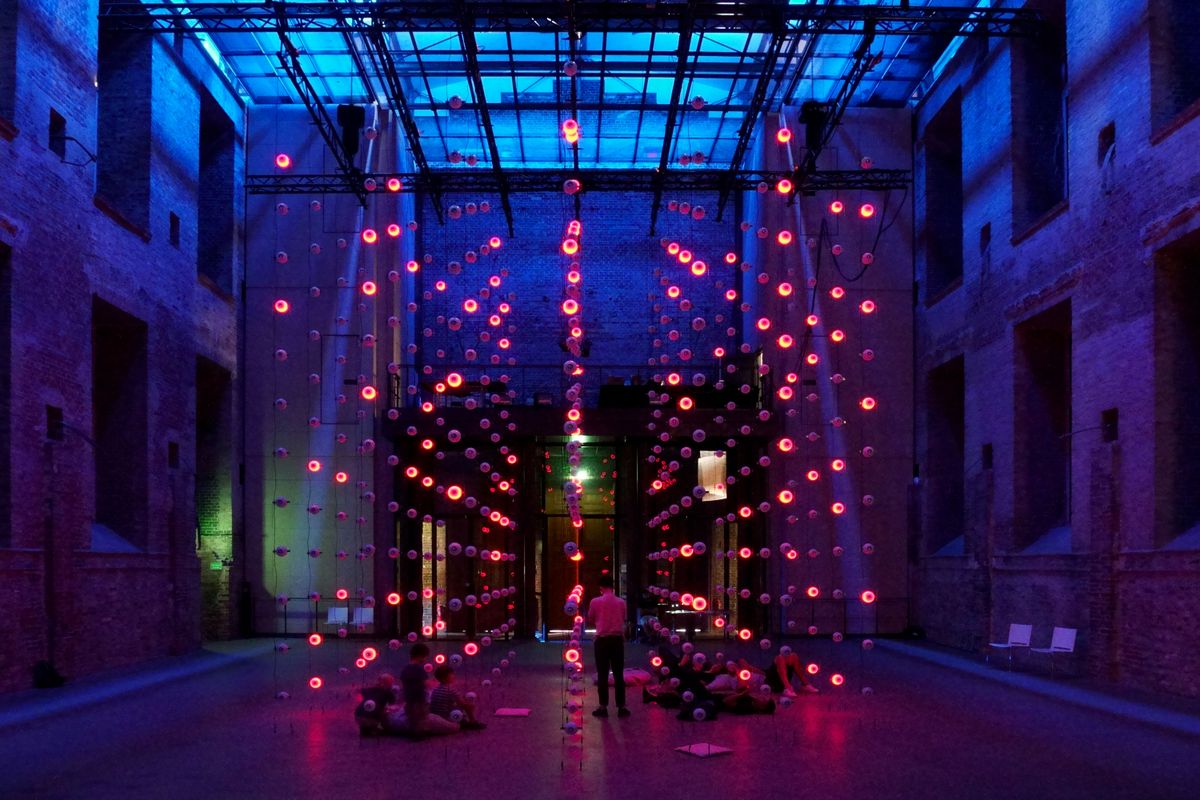
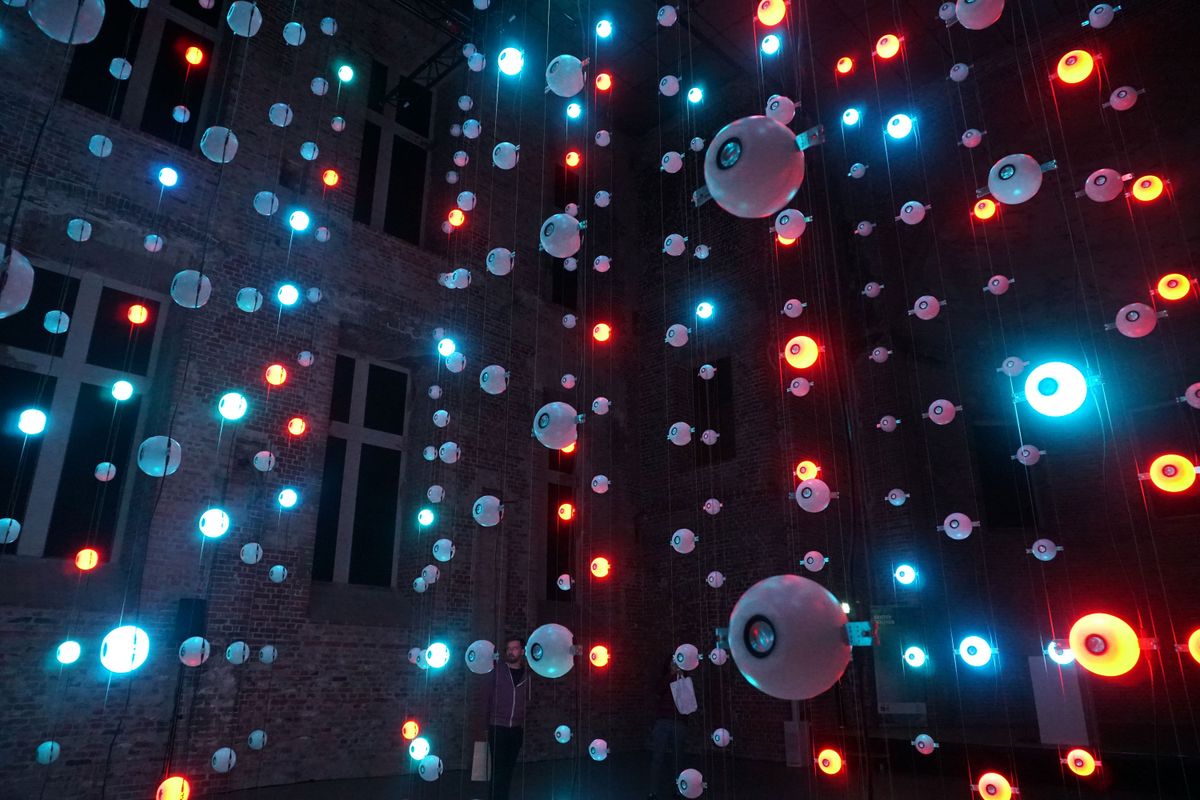
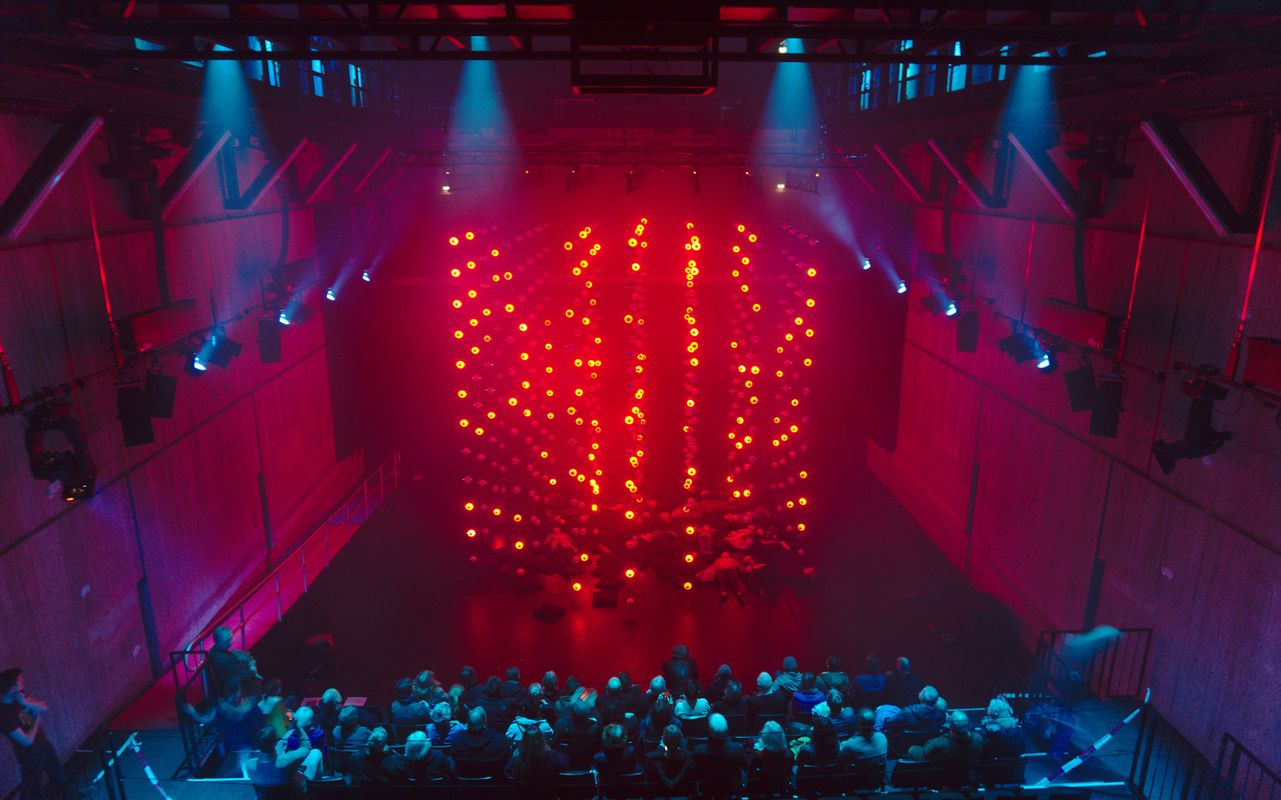
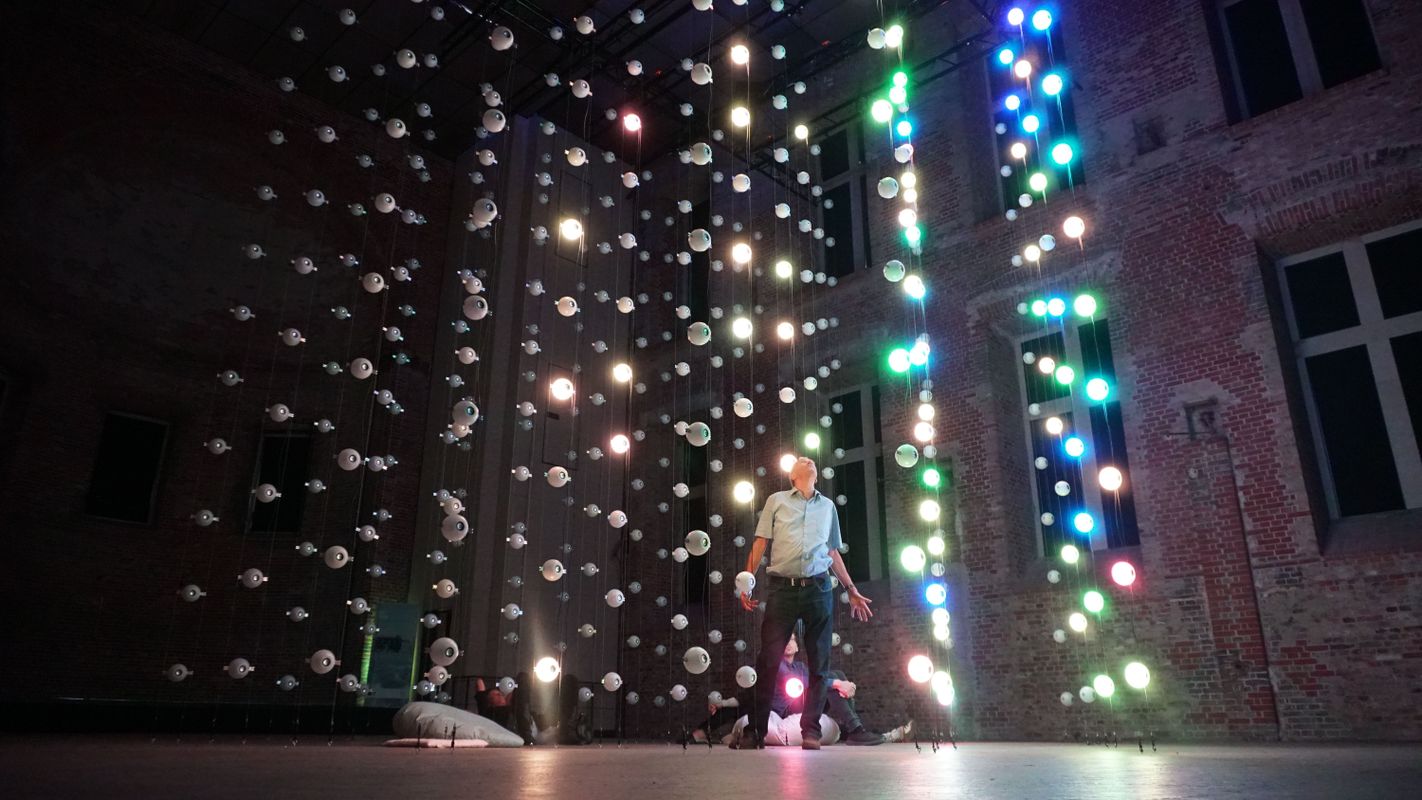
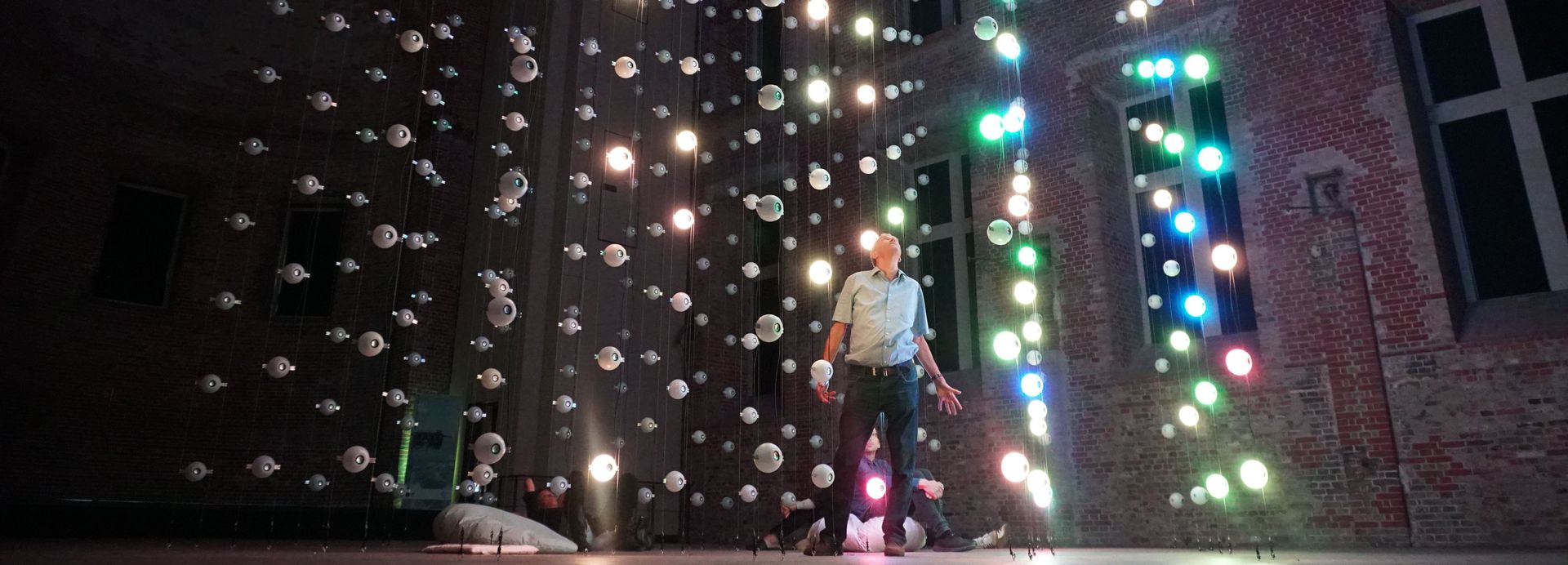
An orchestra of 444 spherical loudspeakers, hanging on thin eight metre long wire ropes, changes the atrium into an immersive sound laboratory. A sensory experience.
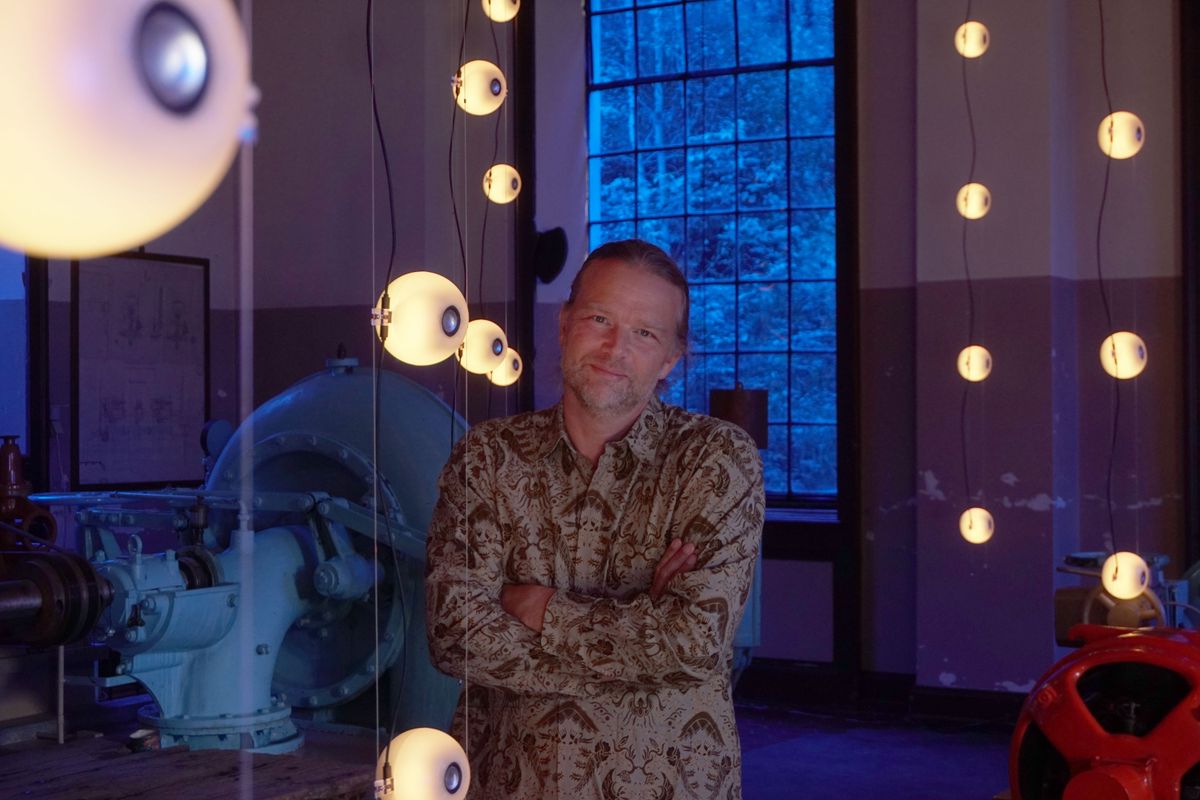
The light and sound installation [aiskju:b] is a work in progress by German artist and composer Tim Otto Roth. The raw material or 'natural score' for his compositions consists of minute traces of light detected by neutrino detectors in the most remote and darkest places on Earth – from the icy depths of the South Pole to the depths of the Mediterranean Sea.
Neutrinos
Neutrinos are ‘ghost particles’ from outer space with extremely high energy, detectable only by highly sensitive instruments. The scientific institute Nikhef has developed such a detector for the two sites of the KM3NeT neutrino observatory, deep below the sea surface off the coasts of southern France and Sicily. The measured light movements are mapped one-to-one onto the loudspeakers, but in an extremely slowed-down form. Depending on the amount of energy measured, the spheres in the light and sound installation light up in different colours and shift in pitch. Through this interplay of light and sound, an entirely new listening experience emerges – an electroacoustic music theatre that invites exploration while walking, standing, sitting or even lying down.

Nobel Prize
In October 2026, it was announced that the physicist Francis Halzen will be awarded the Nobel Prize in Physics 'for decisive contributions to the IceCube Neutrino Observatory and the discovery of high-energy neutrinos of astrophysical origin'. The huge detector array was completed in the depths of the Antarctic Ice in December 2010, and the first high-energy neutrino was detected in 2013. Already in 2010, the first simulations of such an extraordinary event inspired Tim Otto to develop the Astroparticle Immersive Synthesizer³ - short [aiskju:b] - which finally premiered 2018 in Berlin and was also presented in France and Austria. The show at the Muziekgebouw is the Dutch premiere.
Scientific partners: Nikhef – Nationaal instituut voor subatomaire fysica, APPEC - Astroparticle Physics European Coordination, KM3NeT, APC Université Paris Cité, LSPM & CPPM Marseille, IceCube Neutrino Observatory, DESY Zeuthen, SFB 1258 TUM & RWTH Aken University
With thanks to Dorothea Samtleben (Nikhef Amsterdam), Christopher Wiebusch (RWTH Aken), Paschal Coyle (LSPM, Marseille), Christian Spiering (DESY Zeuthen)
With support from Nationaal instituut voor subatomaire fysica (Nikhef) Amsterdam, Universiteit van Amsterdam, APPEC