


György Kurtág 100
'Always on a quest for musical truth'
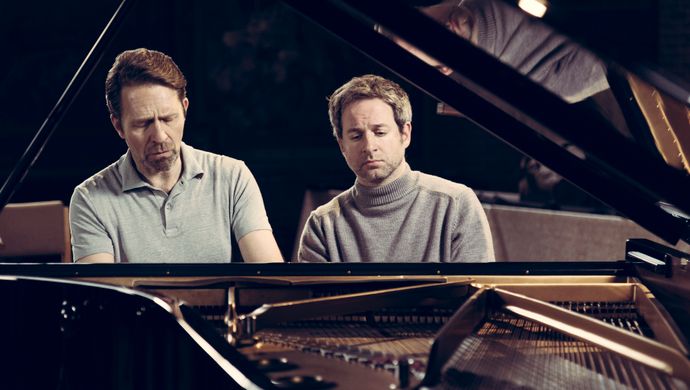
In February 2026, György Kurtág will celebrate his 100th birthday. He is always on a quest for musical truth, preferably in the form of miniatures. Many of the latter can be heard at the Muziekgebouw during the ‘Kurtág 100 jaar’ special. The stage will feature prominent musicians, including pianists Leif Ove Andsnes and Bertrand Chamayou, soprano Anna Prohaska, violinist Isabelle Faust, and the ensemble Het Muziek (formerly Asko|Schönberg).
“Every note he writes is essential. There is never an idea of small talk. His intention is never to please somebody or an audience. For him, there is only the truth, the essential: that you never can lie when you make music.”
- Heinz Holliger, oboist, composer and good friend of György Kurtág
Text: Frederike Berntsen
György Kurtág, born in Lugoj, Romania in 1926, was just eleven years old when he heard Schubert's Eighth Symphony, the Unfinished, on the radio. He asked his parents for the score, studied the music at the piano, and knew right then: being a musician was his calling. Kurtág played piano four hands with his mother and danced with her. As a young child, he wrote his first piano pieces. He refers to Béla Bartók’s music as his native language.
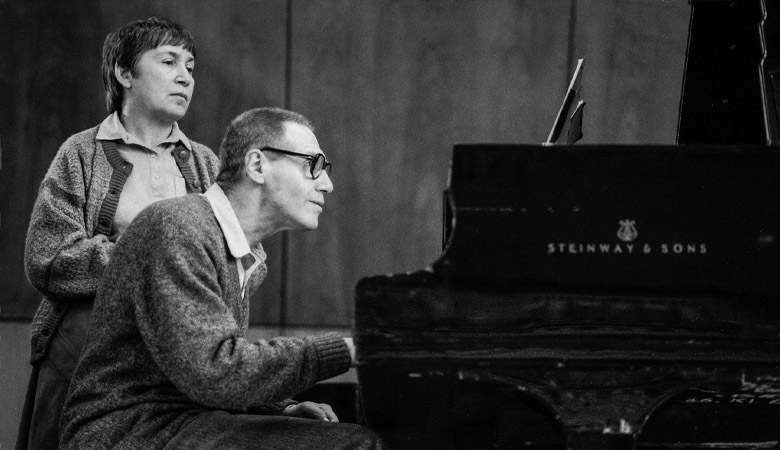
György and Márta Kurtág in 1987 (photo Andrea Félvegi)
While studying composition, piano, and chamber music at the Franz Liszt Academy of Music in Budapest, Kurtág met his future wife, Márta. They were married for 72 years until she passed away in 2019 at the age of 92. She was not only his muse and the mother of their son, but also his editor, advisor, critic, and artistic driving force. The image of the two musicians together behind a piano, playing Kurtág’s Játékok (‘Games’) and his Bach arrangements, is well known to many.
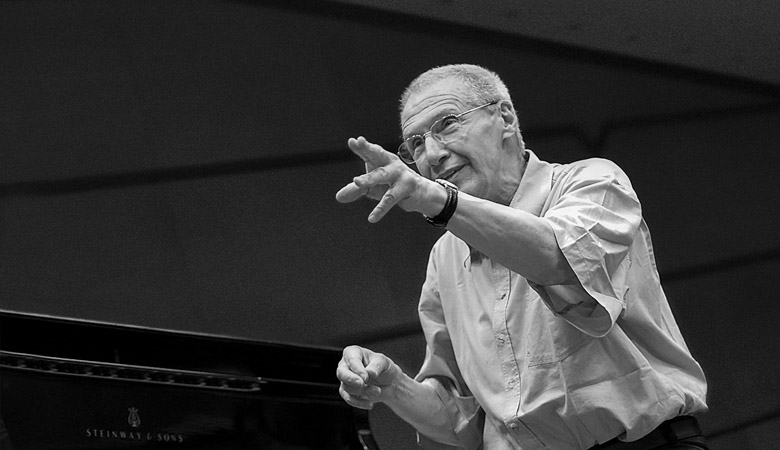
György Kurtág giving a masterclass in 2004 (photo Andrea Félvegi)
Kurtág’s fundamental attitude is one of doubt. He sees teaching as a way of life and has no time for people who are certain of themselves. His friendships are for life. He and his fellow countryman György Ligeti were close friends for six decades.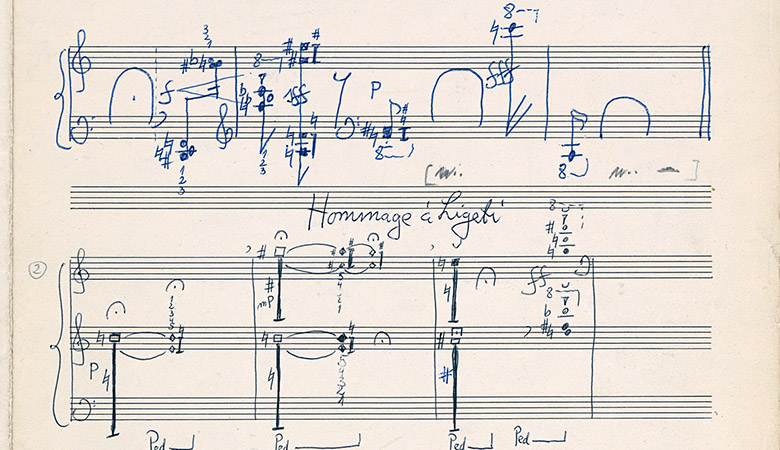
Excerpt from the 2005 score of Játékok “ Hommage à Ligeti” (courtesy Paul Sacher Foundation, Basel, György Kurtág Collection)
After fleeing the Hungarian Uprising in 1956, the Kurtágs arrived in Paris, where the musician took lessons with Olivier Messiaen and Darius Milhaud. It was in this city that Kurtág battled a severe depression. His life was changed by meeting art psychologist Marianne Stein, who set him on a new path psychologically and creatively. It was during this time that he was introduced to the music of Webern, himself a master of the miniature, and the works of Samuel Beckett, who would become a lifelong source of inspiration. After returning to Budapest in 1959, the world in Kurtág’s mind looked different, and the String Quartet he composed at that time became his Opus 1.
International recognition came with Messages of the Late Miss R.V. Troussova for soprano and chamber ensemble. He completed his Opus 50 in 2019, when he was already in his nineties. Composer, pianist, and teacher György Kurtág thinks in terms of musical phrases with a beginning and an end, seeking not a vertical abstraction but a horizontal line. His compositions span a diverse range of instruments, along with duets, trios, and many vocal pieces. And as the saying goes, ‘never say never’: Kurtág’s first opera, Fin de partie, based on a Beckett one-act play, had its premiere at La Scala in Milan in 2018.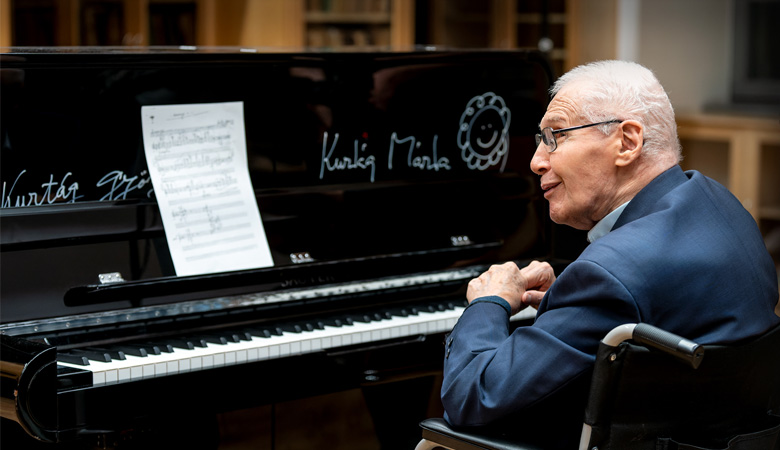
György Kurtág in 2022 (foto Andrea Félvegi)
Kurtág is certainly no stranger in the Netherlands. He was the central artist at the 1987 Holland Festival, and in the 1990s the Royal Conservatoire in The Hague launched an educational project focused on his work. In 2017, an impressive cd box set was released featuring his complete works for ensemble and choir, performed by the Asko|Schönberg and the Netherlands Radio Choir under the direction of Reinbert de Leeuw.
In an interview, De Leeuw once said he knew them all: Boulez, Stockhausen, Nono, Maderna, Cage, Ligeti, Kagel. He thought he had a good grasp of what 20th-century composing was all about. ‘But then I encountered the music of Kurtág. It was a real shock for me, one that completely changed my perception of music. I was familiar with all the excitement these great composers had generated, but I was completely overwhelmed by the simple means Kurtág needs to create his own musical language.’
%20780x450.jpg)
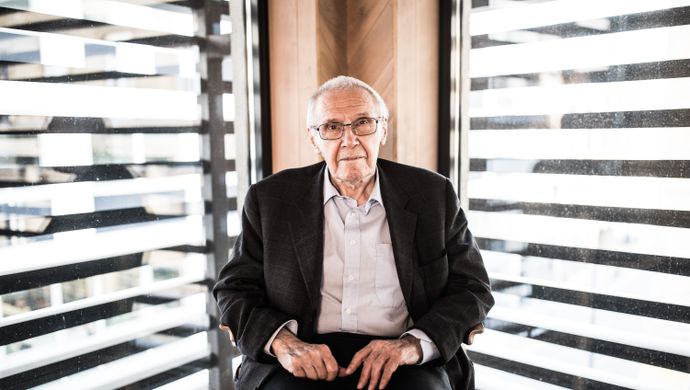
Reinbert de Leeuw (photo Martine Simkovicova)
Over the years, the Asko|Schönberg ensemble, together with Reinbert de Leeuw, has built up a close relationship with the composer, time and again delving deeper into his music. During this Special, the ensemble will perform on February 19, the very day Kurtág will be celebrating his 100th birthday.