





An estranging rural feast
A conversation with Thanasis Deligiannis
Composer and creator Thanasis Deligiannis (1983) wants to bring the rural Greek culture of his youth into the Muziekgebouw. In 2024, he became an affiliated artist at the Muziekgebouw Production House, which will culminate in 2025 in an event where the entire Muziekgebouw is transformed into an estranging rural feast..
Thanasis Deligiannis grew up in a musical family in the Greek countryside. “My mother has been a folk dancer coming from a farmers’ family, and my father is a folk clarinetist,” he says. “As a child, I played percussion, and my younger sister sang. We often performed together as a family.” They did so, for example, during the panegyri, a rural Greek festival celebrating the local saint. Deligiannis loved how the music was part of a multi-sensory experience: the dance, food, social interactions, and setting (plastic chairs, tractors), along with the background sounds of crickets and sheep bells, were all inseparable elements of the celebration.
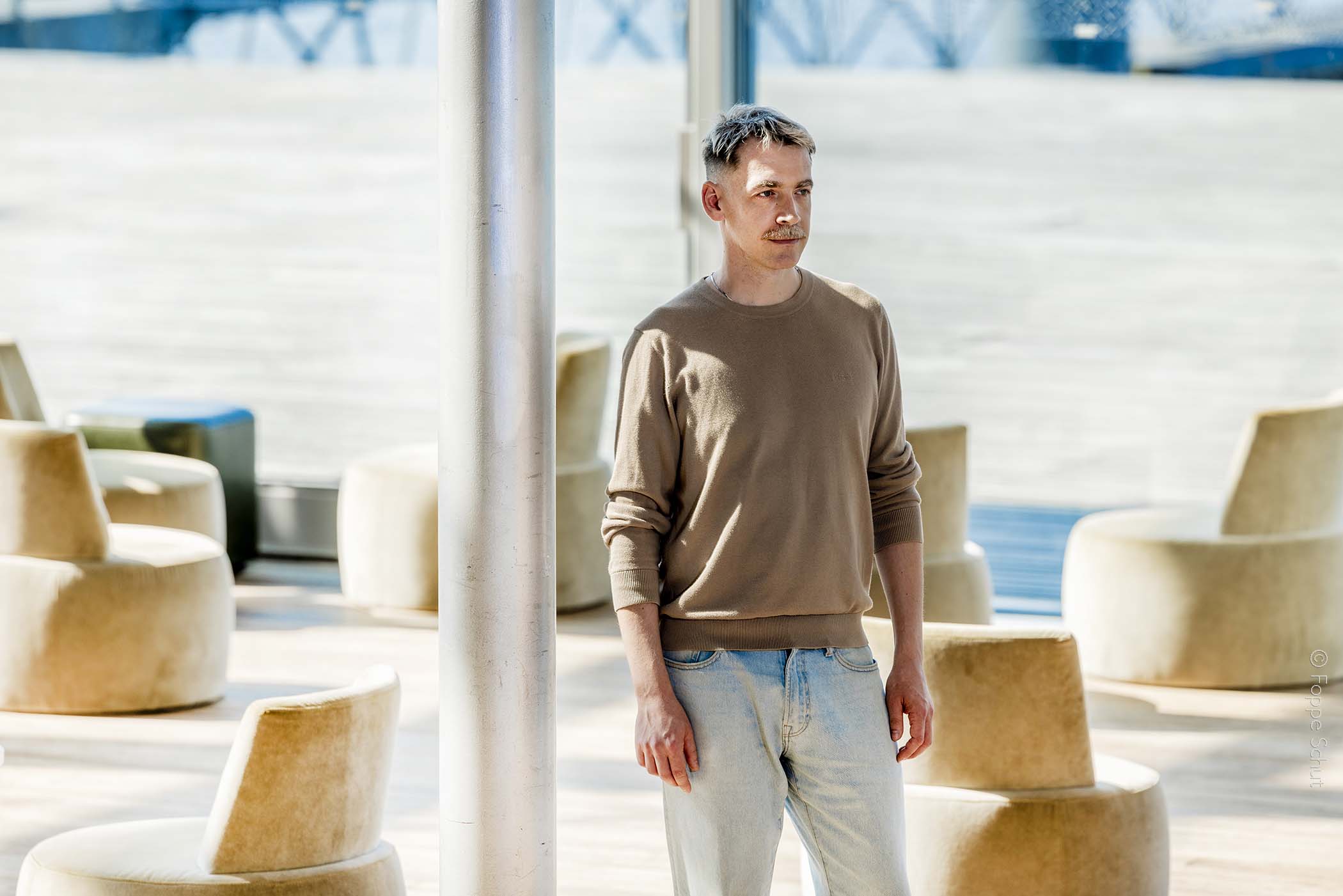
Thanasis Deligiannis (photo Foppe Schut)
Spatial music
Later, as a composition student at the university in Thessaloniki, Deligiannis remained committed to ensuring that his music engaged with its surroundings. “I didn’t want to only write abstract notes on paper; I wanted to create an entire world in which the audience could immerse itself.” His earliest experiment with ‘spatial music’ was his second composition, in which he had musicians move across the university’s basketball court while playing. “But I didn’t yet fully understand what I was doing, and for some of my professors this was a challenge.”
Seeking more creative freedom, Deligiannis moved in 2007 to the Conservatorium van Amsterdam, known for its progressive program. A year later, he was appointed assistant artistic director of the pioneering Nieuw Ensemble. “Our office was in the Muziekgebouw, where I was given a key and had the opportunity to attend numerous concerts and dress rehearsals.” This immersion in new music encouraged Deligiannis to experiment as a composer with a rather transdisciplinary approach, where live music is enriched with performance, dance, video projections, sound recordings, and objects in the space.
.jpg)
The Production House program
He also developed a close bond with the Muziekgebouw. “I got a behind-the-scenes look, saw how concerts are made, and learned about all the technical aspects involved. I discovered that the Muziekgebouw itself is also an instrument, a large machine that offers a composer countless possibilities.” Deligiannis has played with this concept several times, for example, when he removed all the chairs from the Grote Zaal during the talent program An Evening of Today in 2013 and had musicians play tennis with each other. Or during his performance ENA ENA in 2022, when he transformed the rough loading dock of the Muziekgebouw into a nightclub set in the Greek countryside.
To deepen his connection with the Muziekgebouw, Deligiannis was offered a residency at the Muziekgebouw Production House from May to September 2024. The Production House was established in 2023 to offer innovative mid-career creators the space for development and experimentation. “I was given complete freedom to conduct artistic research,” says Deligiannis. “My central question was: how can I compose with the building, and create a composition specifically for this space? I spoke with the technical staff and observed the audience during concerts to see how people respond to the space. I also made trips to the Dutch countryside, where I recorded sounds of the landscape and spoke with farmers. They are the ones who feed the people in the city, so why doesn’t their world play a larger role in urban cultural institutions?”
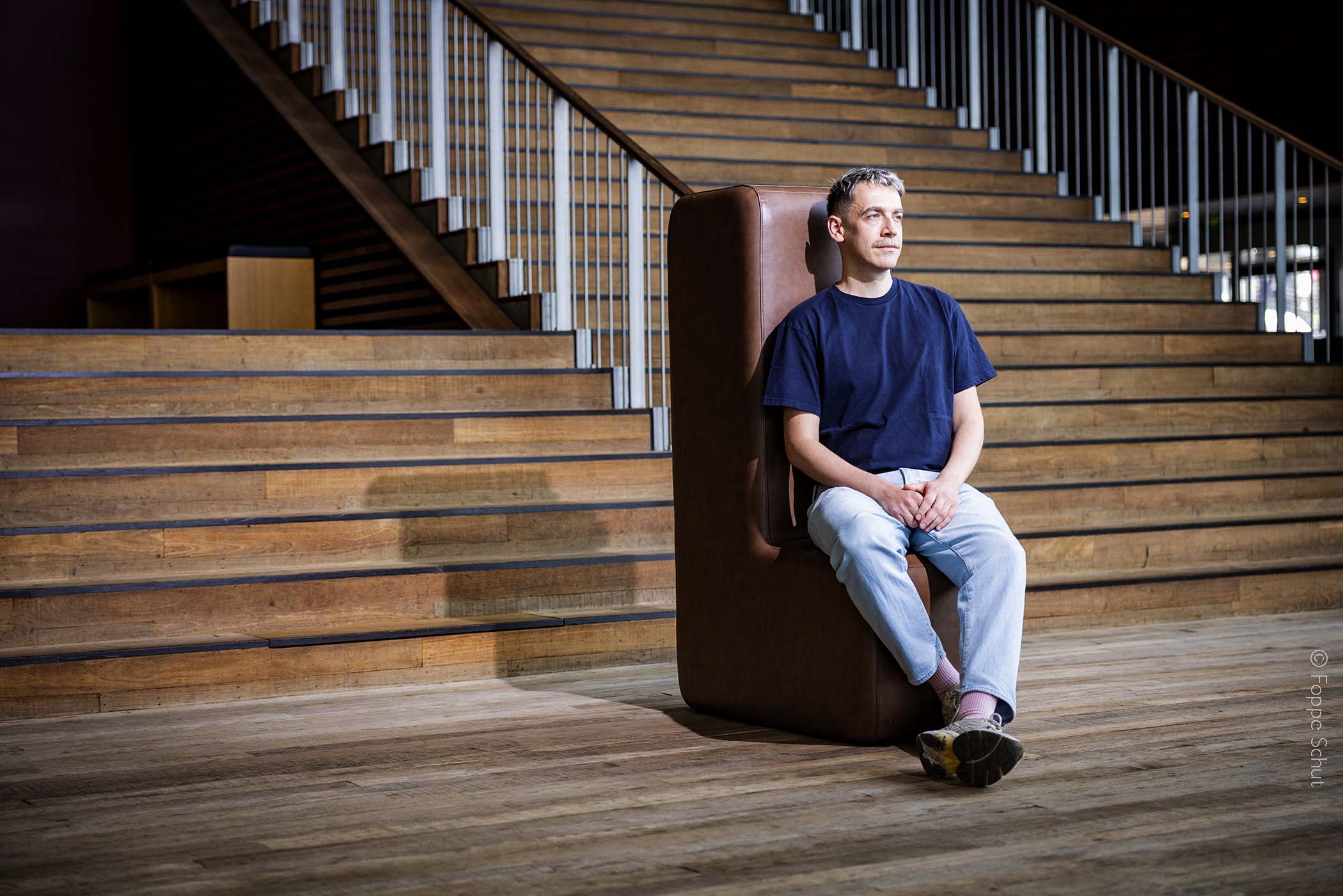
Thanasis Deligiannis (photo Foppe Schut)
Dream logic
In 2025, Deligiannis hopes to turn his artistic research into a multi-day event, where he aims to bring the countryside – and especially Greek rural festivals – into the Muziekgebouw. “On one hand, I see a big contrast: the Muziekgebouw is tall, sleek, and modern, while the countryside is vast, messier, and more traditional. But there are similarities as well, because the countryside is also industrialising: you encounter more and more large sheds, metal structures, and state-of-the-art machines. And just as the Muziekgebouw is surrounded by water, water and irrigation are also indispensable for farming land.”
During his event – “a performative installation” – visitors are free to wander through all the spaces of the Muziekgebouw, from the foyer and halls to the loading dock, each enveloped in a specific atmosphere. “You walk through a fragmentary world full of video images, field recordings, live musicians, lights, and objects that I found at rural festivals. The route you choose determines how you experience the work.” Various types of music blend into each other: traditional Greek folk music and improvisations, acoustic and electronic music, experimental compositions, and a cappella singing. “The work has the logic of a dream. As a visitor, you are invited to create a whole out of it yourself.”
The countryside is most literally brought inside the loading dock, where Deligiannis wants to place a dripping irrigation machine. This same agricultural machine previously played a role in Xirómero/Dryland, an interdisciplinary collective installation at the Greek Pavilion at the 2024 Venice Biennale, conceived by Thanasis Deligiannis and dramaturg Yannis Michalopoulos, created together with artists Elia Kalogianni, Yorgos Kyvernitis, Kostas Chaikalis, and Fotis Sagonas. “As a child, I was deeply fascinated by my grandfather’s irrigation machine. Now, we’ve prepared a new version together with Yannis, somewhat like how you might prepare a piano. The machine has become an instrument and forms the beating heart of our project.”
Text: Myrthe Meester.
This article previously appeared in Vriendenmagazine DichtbIJ.
Muziekgebouw Production House
You do not programme this, you create this
To be ahead of the curve requires driving development, daring to experiment, seeing talent and offering support. Through the Production House, we aim to foster the growth of creators, music and the creative landscape that is part of it. We provide a fertile environment for mid-career creators to freely experiment, research, test, and ultimately excel. This benefits not only the creator, but also contributes to the growth of the Muziekgebouw itself. It is how we continue to be at the forefront of the (inter)national music scene.
Read more about Muziekgebouw Production House
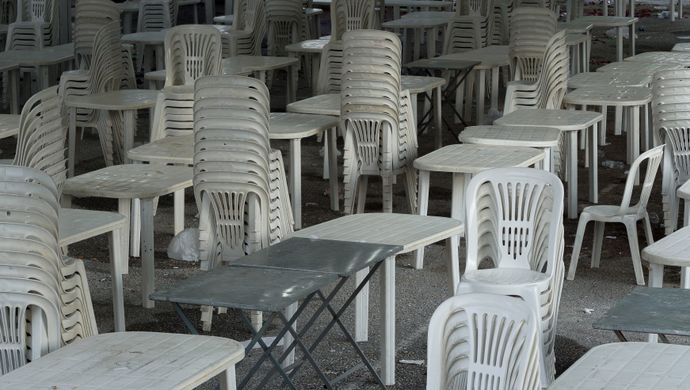

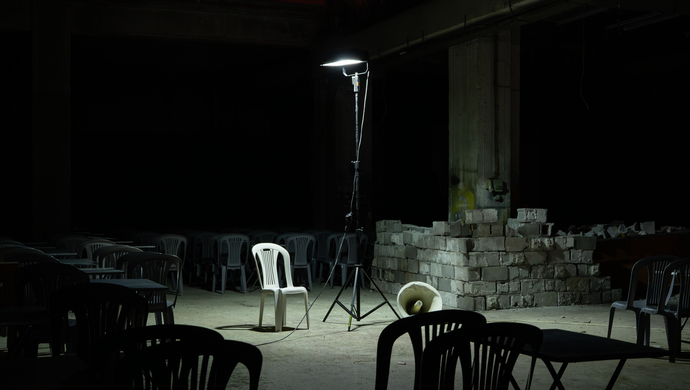
Nightwater: performance installation
Thanasis Deligiannis + Ensemble Klang