





Thanasis Deligiannis on Nightwater
‘Where does a song go when the last notes have faded away?’
This autumn, transdisciplinary artist Thanasis Deligiannis will transform the Muziekgebouw into an enormous resonance chamber. With Nightwater, he will make the building vibrate. The piece, composed for musicians, performers, installations and videos, will, for a single weekend, build a bridge to the festive celebrations of the Central Greek countryside.
By Dana Linssen

(photo: Elia Kalogianni for I/O and Onassis Stegi)
If there is one memory that has come to define the artistry and the spatial, immersive compositions of Thanasis Deligiannis (Greece, 1983), it is the sound of the panighíri. These are the large folk festivals that take place in the summer in the countryside where he grew up, and to which his parents would take him. He comes from a family of farmers who were also musicians. His father played the klarino, the Greek clarinet with its instantly recognizable folk sound. Sometimes, when it got late, he would be tucked into the car, where he would be lulled to sleep. Fragments of muffled music, talking, voices rising, sounds fading away. And silence. Crickets. And then, he says, it was as if he were lying inside a resonance chamber.
For one weekend this late summer, he will turn the entire Muziekgebouw into a massive resonance chamber. His transdisciplinary installation, Nightwater, will send vibrations rippling through the building, from the Loading Dock and backstage areas to the Grote Zaal and rehearsal studios. Using the building as an instrument, he composed a piece for musicians, performers, installations, and video art. From 12 to 14 September, in Amsterdam, this work will echo the sounds he heard and dreamed of as a child in that state of half-sleep.
(photo: Pinelopi Gerasimou for Onassis Stegi)
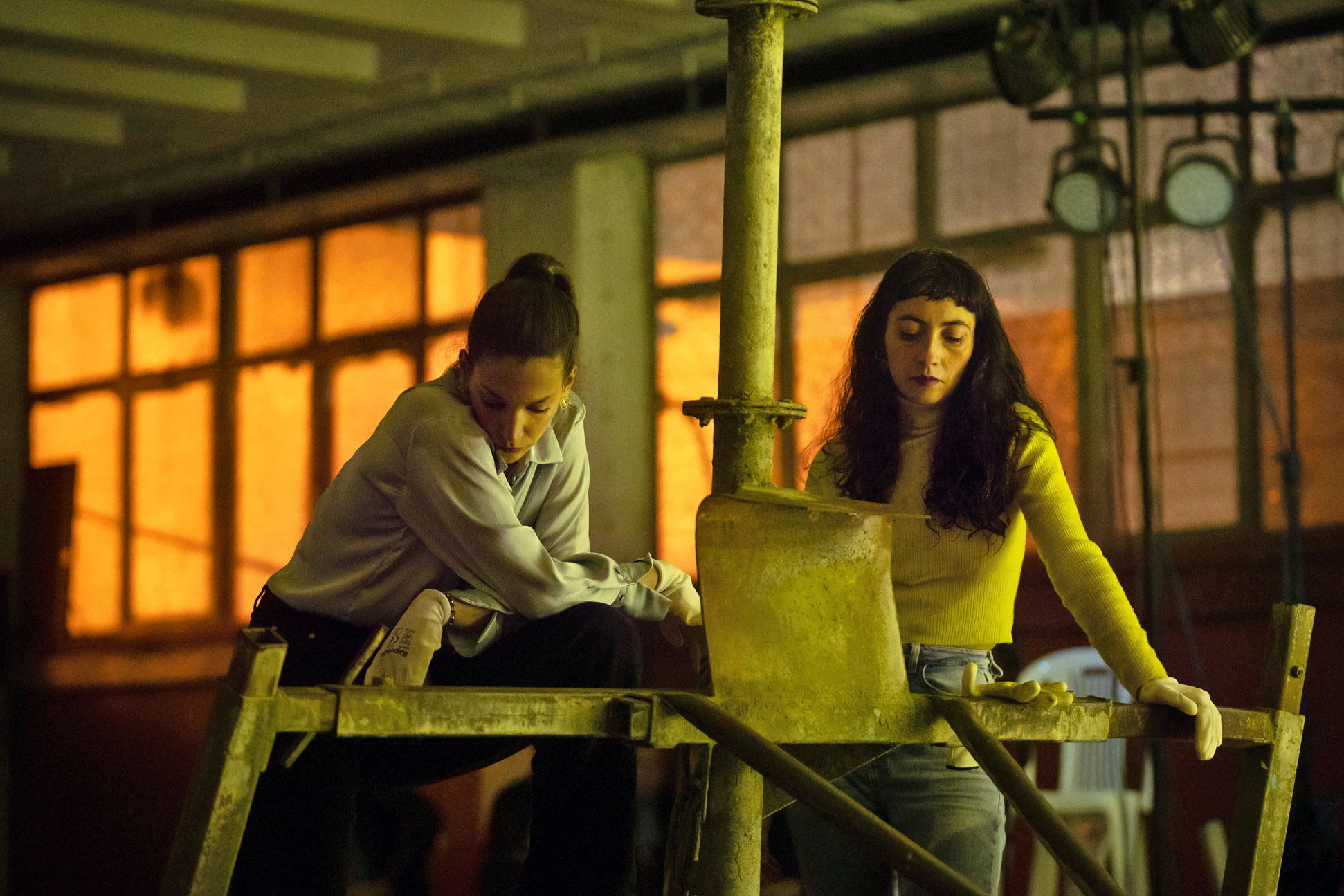
Irrigation machine
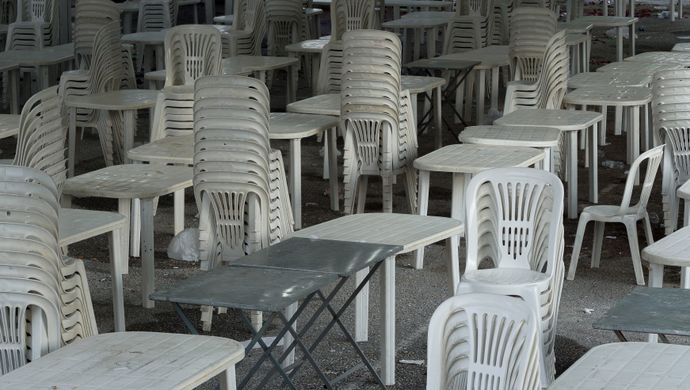
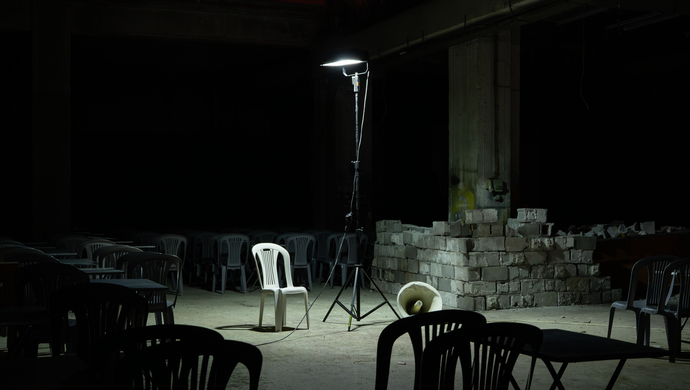
Nightwater concludes a residency at the Muziekgebouw Production House and builds on the collective works Deligiannis created before, including for the Greek Pavilion at last year’s Venice Biennale. Anyone who saw Xirómero/Dryland there got a sneak peek of the experience now awaiting them in Amsterdam. The centrepiece was a massive irrigation machine that was activated at regular times to spray the concrete floor of the Neo-Byzantine building. It offered a blessed relief from the sweltering summer that tormented the Venetian Lagoon. In the dark exhibition space, white plastic patio chairs were scattered across the floor, some upright, some toppled. It looked as though visitors had just gotten up and left. Lingering in the air were the echoes of a party, the sounds of nature at night and people working in the distance. They called to mind the timeless labour of man and his relationship to technology and nature. The farmer was gone, but the plough ploughed on.
.jpg)
(photo: Pinelopi Gerasimou for Onassis Stegi)
Both Xirómero/Dryland and Nightwater grew out of a long-term research project that began in 2022. With support from the Onassis Foundation, Deligiannis and the dramaturg and philologist Yannis Michalopoulos delved into the life of the legendary Greek folk singer Kiki Margaroni, who was the voice of the panighíri throughout the 1970s and 1980s. ‘Her style of singing was unique, very slow. In other regions, certain songs may sound cheerful, but she imbued them with a certain gravitas, a certain contemplation. I believe this allowed the big themes of life, like loss and love, to really come to the forefront.’
When they had finally tracked her down, they discovered she had retreated from public life and did not want to participate in the project. ‘At that point, absence became the dominant theme of our research’, Deligiannis explains. They decided to explore the liminal spaces and moments between tradition and memory, between the end of one celebration and the beginning of the next. ‘Where does a song go when the last notes have faded away, when there is no one left to sing it? Where do sound waves travel when they are said to die away? What is the future of the rural culture that shaped me as a child?’
During research trips to Thessaly (Central Greece) and Xirómero (Western Greece), they collected sounds – not only of folk music, but also of work on the land – as well as interviews, photographs and films. The question that Deligiannis and his team set out to answer was almost archaeological. It wasn’t: how can you reconstruct the heyday of the panighíri from all those fragments and stories, those memories and artefacts? Rather, it was: can you deconstruct and re-compose the soundscapes and echoes of those folk festivals? The intention was not to crystallize these events in time, but to enable them to resound in a new form, much like how sound itself changes, transforms, and is carried onward under the influence of environmental factors, through time and space. Different and yet the same.

(photo: Pinelopi Gerasimou for Onassis Stegi)
The dream of the machine
Guests can move freely through the building during Nightwater. The irrigation machine that was in Venice is back, playing a starring role. ‘I was fascinated as a child by my grandfather’s irrigation machine. By the sound of the artificial watering. The creaking of the mechanism. During our research, it became both a personage and an instrument, a bit like a prepared piano. I don’t want to give too much away to the audience’, Deligiannis said as he put the finishing touches to the work shortly before the summer. ‘What you will experience at the Muziekgebouw is something that you could imagine as the machine’s dream.’
The route begins at the Loading Dock, where the irrigation machine enters the scene. It is a dancer among other dancers. Is the machine being pulled along by the musicians and performers, or is it actually the immense apparatus itself, with its enormous water hose, that sets these people in motion? A mysterious choreography for machine, man and water. Nightwater deliberately uses these kinds of alienation techniques, making everything feel both familiar and strange by first decontextualizing it and then recontextualizing it. Music plays, a dance track kicks in, then seems to briefly falter. Is it about to start, or has it already ended? Are these sounds swelling or fading away?
.jpg)
(photo: Yorgos Kyvernitis for I/O and Onassis Stegi)
The visitors then walk through the spaces between the backstage corridors to the Grote Zaal. Various performative, musical, light, and sound elements spark curiosity. A video features footage captured by Deligiannis and his team. Empty chairs. Musicians chatting in a darkened dressing room. Has the party just ended, or is it about to begin? A dancer walks by. Where is he going? Where is that sound coming from? Echoes and amplification, delayed and bouncing sounds from tiny speakers, slowly bring the whole building to life with a sense of auditory motion. Crickets sing, as if you have been dropped into a field at night. A dog barks. In the distance, a car drives off.
Then you enter the Grote Zaal, where the seats have been replaced by an installation performance of white plastic patio chairs. A meadow of chairs. You can walk through it or take a seat. Maybe something will happen. Maybe not. A life-sized screen shows a group of men who have finished their day’s work. They are washing up, are cutting each other’s hair, and grooming themselves for the evening’s festivities. Here, the old and the new Greece meet. The Greece of traditions and tragedies encounters the Greece where a new economic reality is taking shape. In their faces, we recognise the sons of generations of farmers and seasonal workers from all corners of the world.
A clarinet player walks through the rows of chairs, playing his tune. Should you follow him? If the tryouts taught us anything, it is that as a night-time wanderer, you shouldn’t try to get ahead of the music. Nightwater invites you to linger, to slow down. The Entreehal and the Foyerdecks are also the scene of small events. A singer waters dried-up plants. More video films. Until finally, the Kleine Zaal becomes a sanctuary of deep sleep. Here, the sprinkler machine dreams itself into being. There is video footage of a country road at night, set to an ambient soundscape weaving together the tones of a microtonal organ and electronics. These are vibrations of sounds we don’t normally hear. Frequencies that propel us toward that moment where memory, dream and future vision intersect like country roads. Technology that dreams the past.
Childhood memories
For anyone who has ever attended a performance by Deligiannis at the Muziekgebouw, some elements will feel familiar. In 2013’s An Evening of Today, for instance, he cleared out the Grote Zaal and had musicians play tennis, an act to activate the hall’s acoustics. His 2022 performance ENA ENA saw the Loading Dock reimagined as a Greek countryside nightclub from the 1980s, a concept that returns in a deconstructed form in Nightwater.

(photo: Pinelopi Gerasimou for Onassis Stegi)
If Nightwater is ‘the dream of the machine’, then the water machine dreams of Deligiannis’ childhood memories. ‘My mom always used to joke about how you could put me to sleep next to, or even better, in a speaker. I’m realizing more and more that I don’t create sound designs or music, but rather, I compose experiences and spaces in my work. Hearing is a 360-degree experience. You can hear sound without seeing it. It can come from behind you. From afar. Further than your eyes can see. Sound can be disorienting, but if you listen carefully, you can also use sound to orient yourself. Sound is a dialogue with space. But when I experience the world, I am not just surrounded by sound, I am in the sound. That means that ultimately I don’t compose sound, but space, with sound as my guide.’
The structure also follows a dreamlike logic. In the end, it is the viewer who decides how long they want to stay in a space or if they want to go back. ‘Nightwater conjures a fragmented world of video images, field recordings, and live musicians, all of which are an echo of our research into rural culture. You will hear traditional Greek music, but also experimental compositions. There is room for improvisation, and there are pre-recorded loops. As a viewer, you create your own story, your own experience. You witness what is happening, but you also become part of the whole.’
The world of water
By now, Deligiannis knows the Muziekgebouw inside out. But until recently, he had only explored the inside: the building’s organs, its lungs, its reverberation chambers. For the first time, however, he realized that by including the Entreehal and the Foyerdecks in his work, the glass architecture began to take on a role of its own. He chuckles: ‘Nightwater is about the world of water. The land, bone dry by day, gets watered at night. Imagine a massive cruise ship pulling up to the terminal next door. Or a big storm, with waves from the IJ slamming into the quays. I have no control over any of that, but I love to fantasize about it.’
He continues: ‘I find it a thrilling challenge to introduce the culture of the countryside into a place like the Muziekgebouw. Music from all over the world is performed here. But the music and songs of the panighíri have a certain rawness, with form, professional skill and aesthetics being perhaps less important than pure expression. When you bring these worlds together as an artist, you are naturally aware of the political tentacles that extend beneath the work. We live in a time in which the agricultural world is under fire, is reinventing itself. These aren’t the issues you usually stumble upon in a city’s cultural hub. All of this will contribute to the work’s meaning, without me ever having to spell it out.’
For this reason, he also composed emptiness and silence within Nightwater. ‘People can encounter each other and feel how they are part of a community. But they can also encounter and hear their own thoughts, memories and dreams in the reverberations of the Muziekgebouw.’

(photo: Yorgos Kyvernitis for I/O and Onassis Stegi)

Nightwater: performance installation
Thanasis Deligiannis + Ensemble Klang