


SoundLAB at the Stedelijk Museum
10 January 2024
What does ‘square’ sound like? What sound does ‘yellow’ make? And what do they sound like together? Music is an important source of inspiration for many artists. Some incorporate musical elements such as rhythm, contrast and repetition into their work. Others see colours and shapes when listening to music.
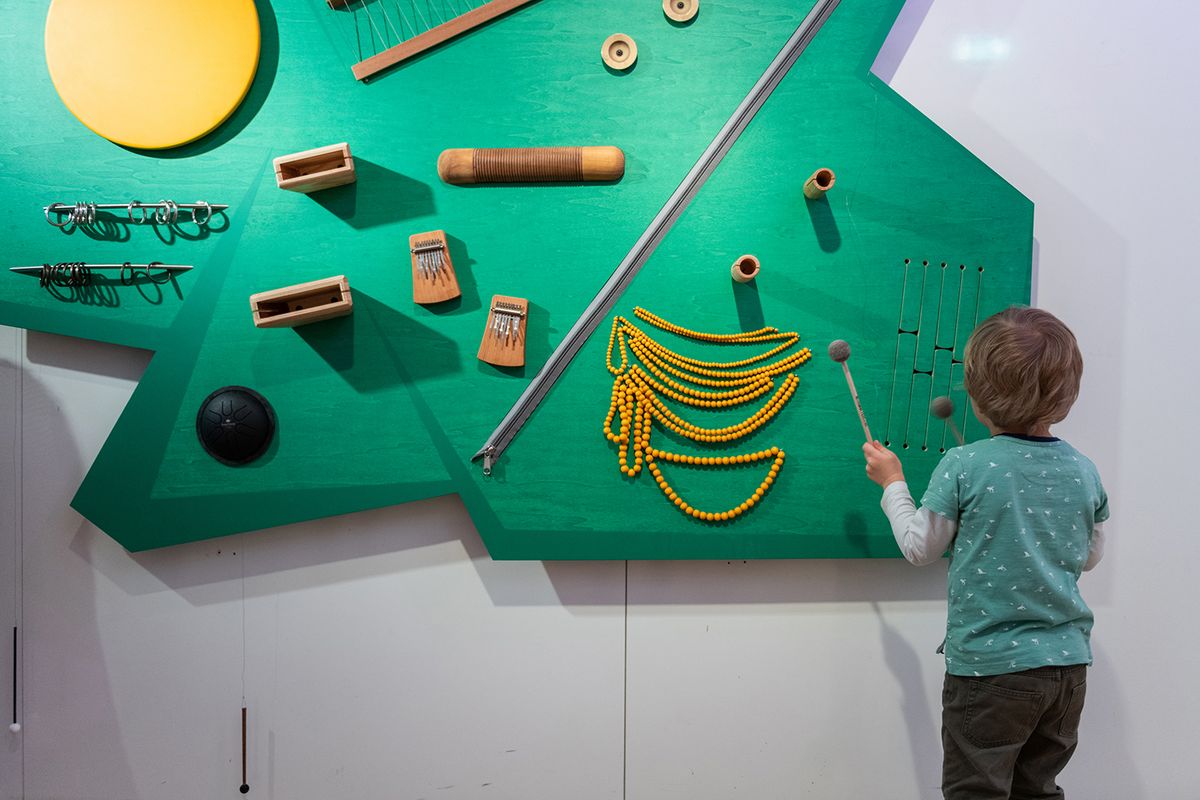
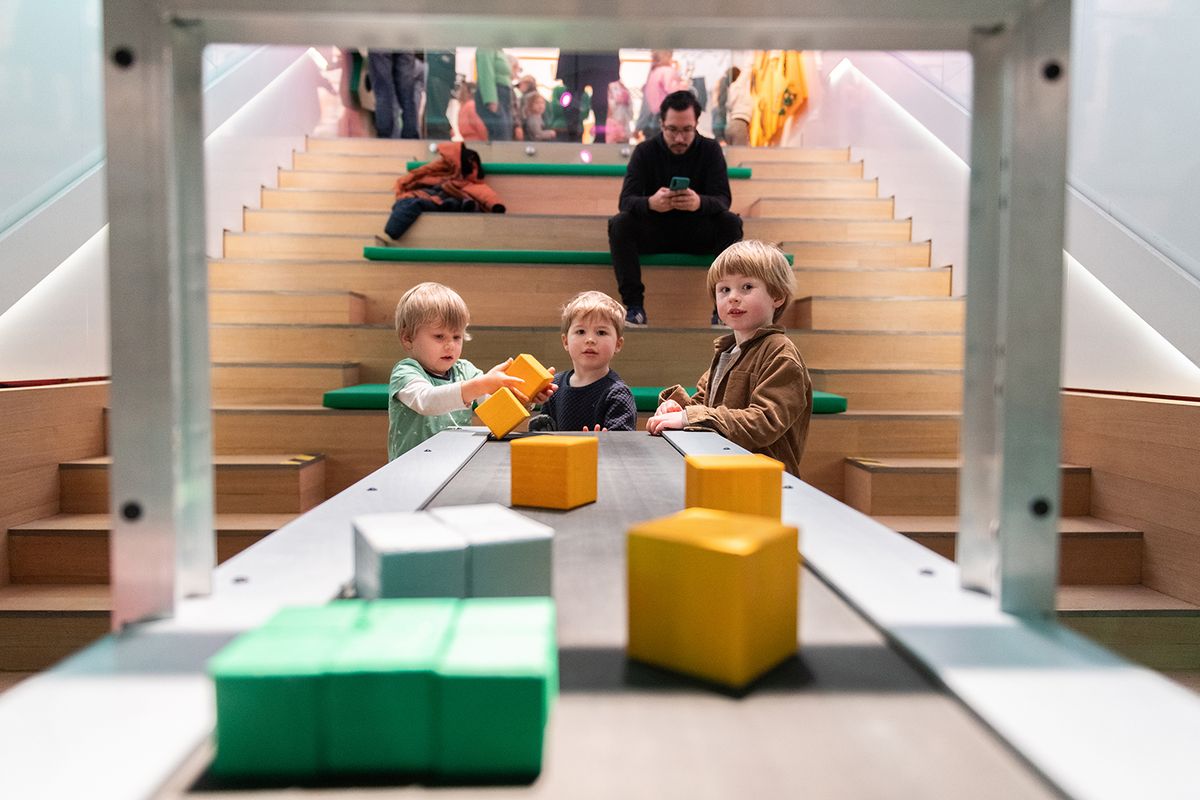
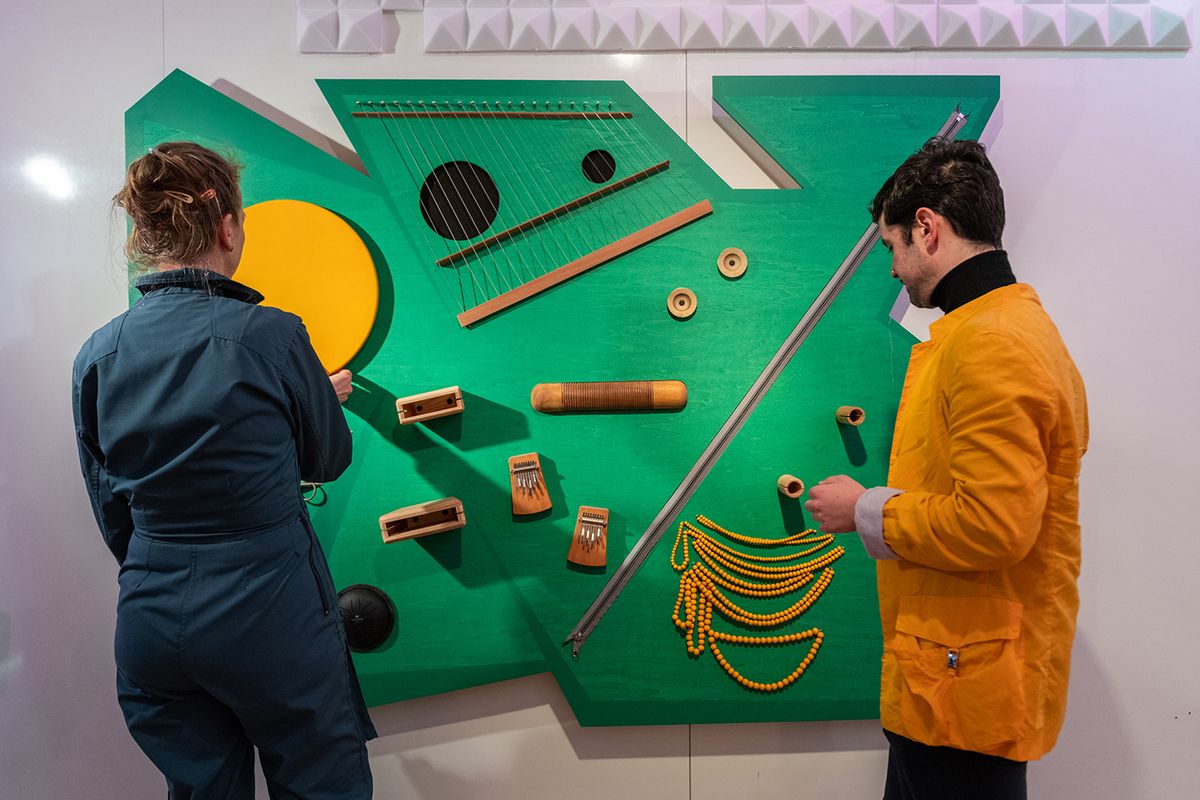
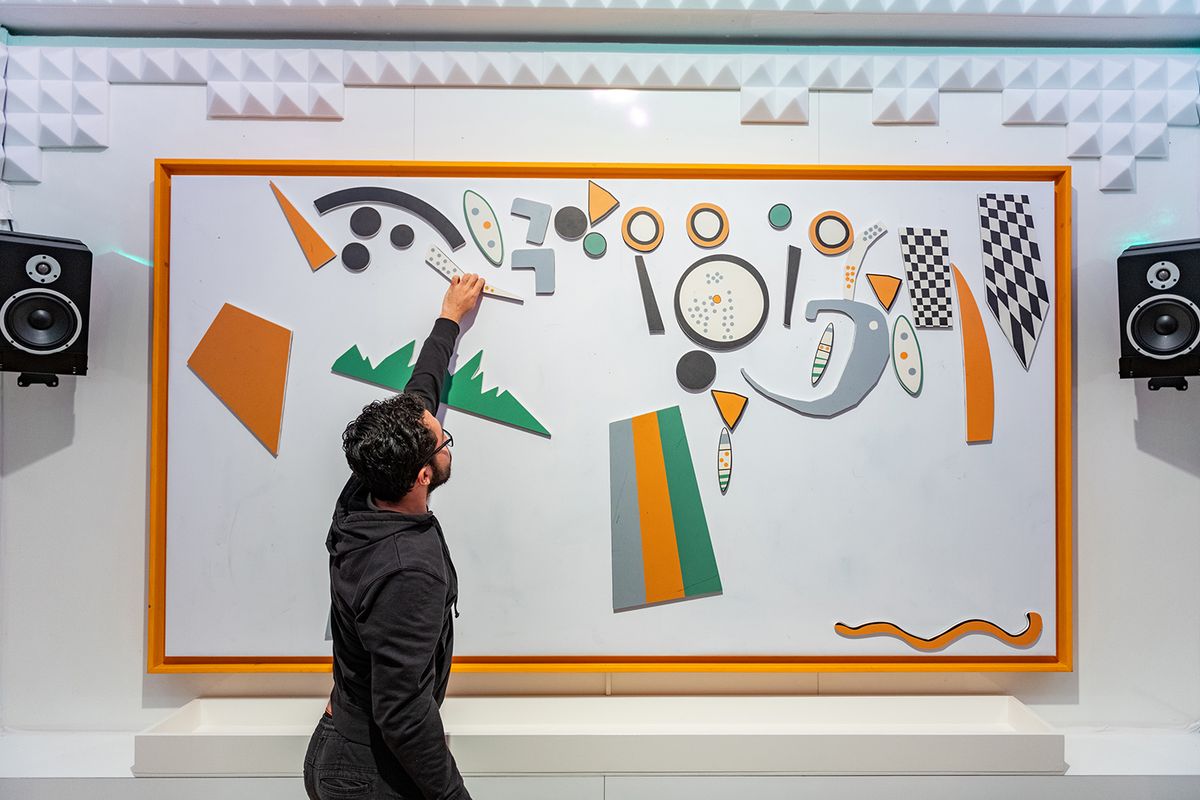
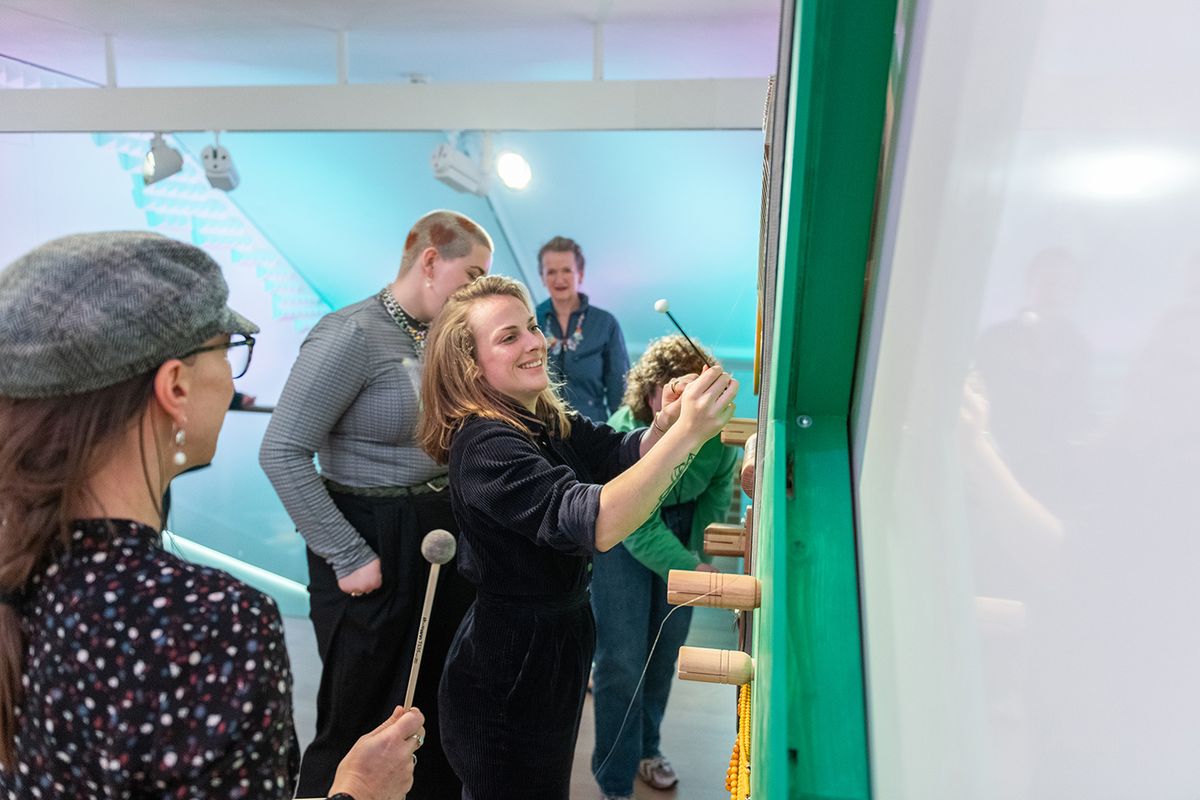
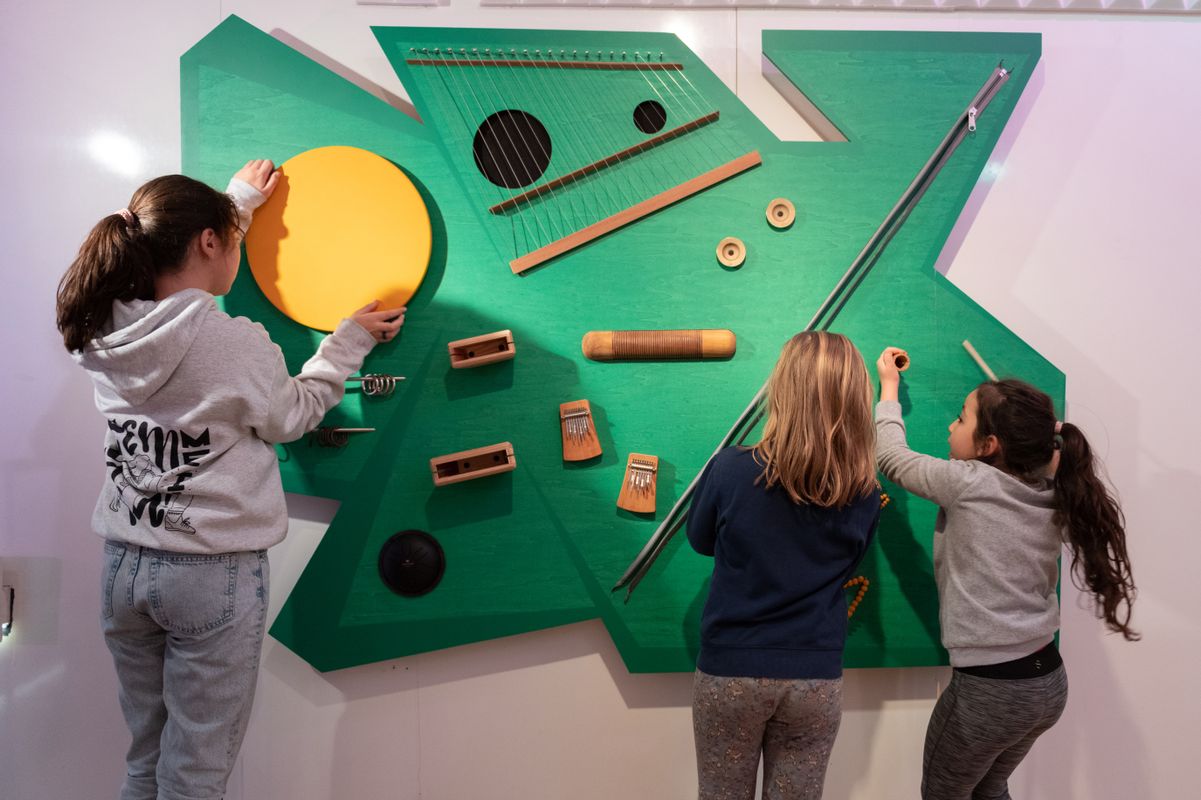
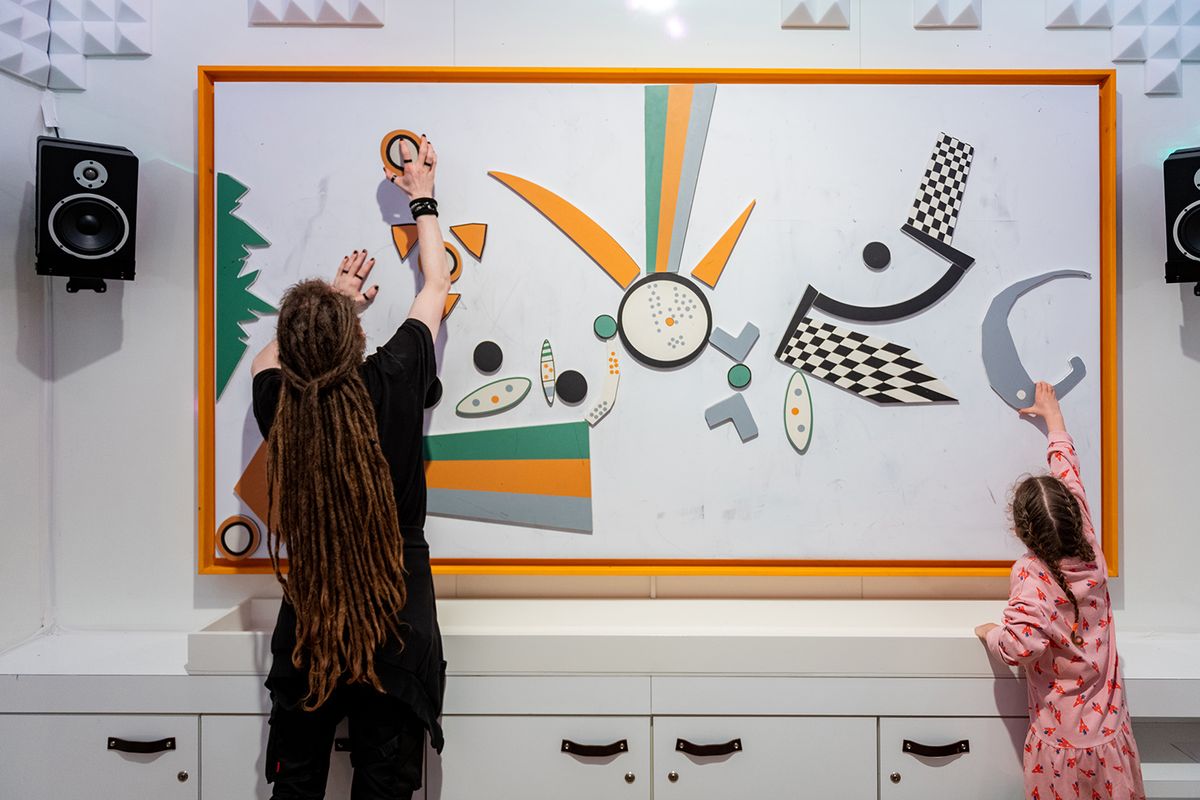
The MODERN exhibition was on display at the Stedelijk Museum Amsterdam from 24 February 2023 until 7 januari 2024. The Muziekgebouw has created three special SoundLAB installations for this exhibition, inspired, amongst other things, by the work of artists Wassily Kandinsky and Sedje Hémon. In this SoundLAB, visitors can explore how image and sound come together to form a new narrative. The installations are called Kandinsky Canvas, Factory Music and Touch and Pluck Walls.
Maurice Rummens, co-curator of the exhibition, wrote the following commentary on the relationship between Kandinsky and music:
Kandinsky and music
From the early 20th century onwards, the Russian-German artist Wassily Kandinsky (1866 – 1944) sought to develop a new, abstract visual language through which specific emotions could be expressed. Drawing on the prestige enjoyed by music as an abstract art form, he emphasised the purely visual aspect of painting, at the expense of the figurative, narrative element.
Kandinsky characterises the intended visual language using a musical term: ‘Generalbass’ (basso continuo, ‘figured bass’), the lowest part of a musical piece, which clarifies the progression of the harmony. In 1914, he began to work consciously on his ‘Generalbass’, and in 1926 the result was published: the book Punkt und Linie zu Fläche (Point and Line to Plane).
This book marks Kandinsky’s clear transition, in the mid-1920s, to geometric abstraction. In Punkt und Linie zu Fläche and in his teaching at the Bauhaus, an influential art and architecture college in Germany, from 1922 onwards, he referred to the point as the ‘primordial element of painting’, the line as a point set in motion, and linked colours and forms to emotions. Kandinsky also included graphic scores in his book Punkt und Linie zu Fläche.
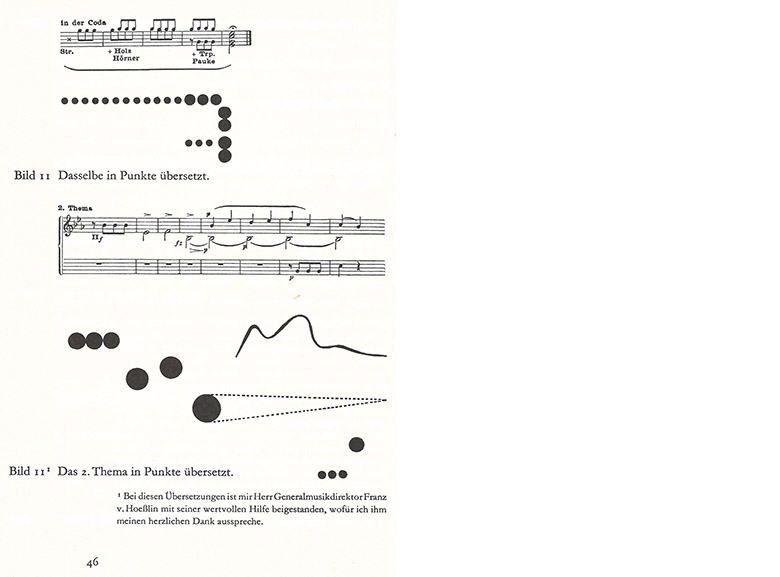
Wassily Kandinsky, Punkt und Linie zu Fläche, p. 46. ©1955 Nina Kandinsky, Neuilly-sur-Seine, book design Max Bill
Synesthesia
Kandinsky constantly writes about visual art in musical terms: colours and shapes have an ‘inner sound’; the artist plays a ‘colour keyboard’, the strings of which are located in the human soul – through his use of colour, the painter ‘sets these strings of the soul vibrating’. This view ties in with the 19th-century interest in synesthesia – the perception of colours as sounds and sounds as colours – a phenomenon which, according to experts, appears to be experienced by four per cent of the population.
Kandinsky himself had a powerful synaesthetic experience in his youth: whilst attending a performance of Wagner’s Lohengrin in Moscow, he had a marvellous vision of colours and lines. He explains the phenomenon of synaesthesia using a musical analogy: a sensation from one sense is transmitted to another, just as in music one instrument causes another to sound without the latter being played; or just as one part of an instrument causes other parts to vibrate in unison. He cites two pianos as an example. A note struck on one instrument causes the same note to resound on the other. His work, incidentally, is not painted music. The very nature of the visual medium remains a given for him: he ‘listens’ to the paint or ink.
Prior to Kandinsky’s 1922 series of prints Small Worlds, he had become acquainted in Russia with the geometric abstraction of Suprematists such as Kazimir Malevich and Constructivists such as Vladimir Tatlin. The lithograph Small Worlds IV, with its sharply defined geometric forms, foreshadows the geometrically abstract works that Kandinsky began producing from the mid-1920s onwards.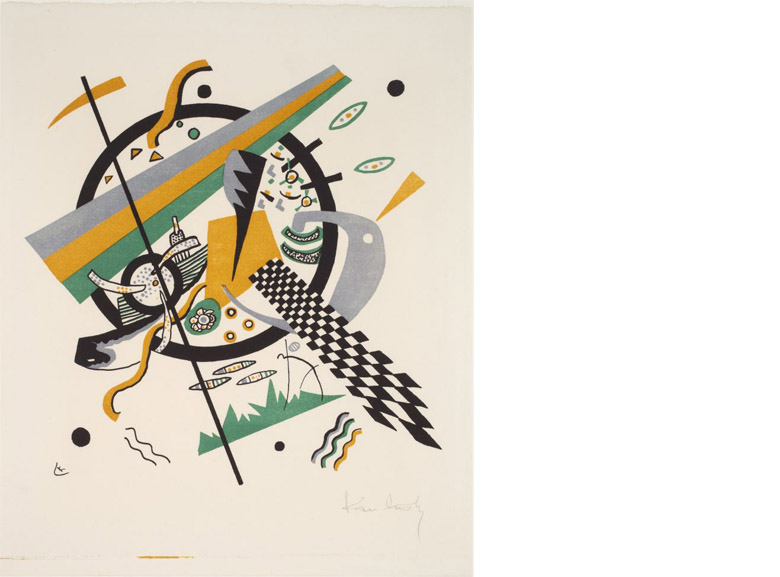
Wassily Kandinsky, Kleine Welten IV / Small Worlds IV, 1922, lithography, 35,9 x 28,9 cm, Stedelijk Museum Amsterdam, acquired 1955
Kandinsky also incorporates score-like forms into his paintings and works on paper. For example, in 1934, after fleeing Nazi Germany for Paris, he painted Two Frames with Music-Score-Like Elements (fig. 3).
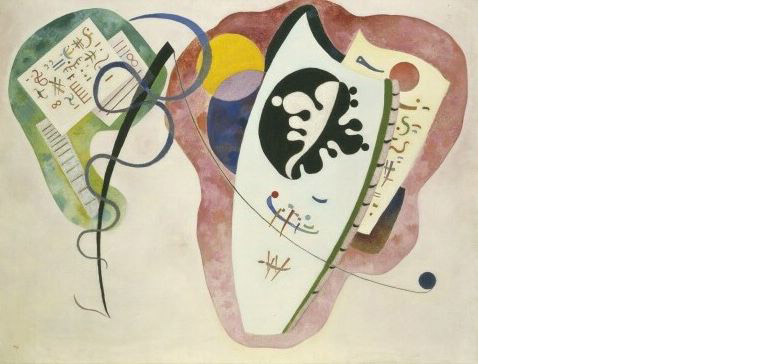
Wassily Kandinsky, Deux entourages / Two frames, 1934, oil and sand on canvas, 89 x 116 cm, Stedelijk Museum Amsterdam, on loan from the Cultural Heritage Agency of the Netherlands (RCE), formerly in the Regnault collection.
Text on Kandinsky: Maurice Rummens, research assistant at the Stedelijk Museum Amsterdam
SoundLAB Muziekgebouw
At Muziekgebouw aan 't IJ, you’ll find the original SoundLAB, where the focus is on discovering new sounds with marvellous instruments.