





In search of the treasure
A portrait of conductor Bas Wiegers
March 2026
By Joep Stapel
Five years ago, conductor Bas Wiegers was the Muziekgebouw’s featured ‘Zielsverwant’ (Kindred Spirit). In the ‘Zielsverwanten’ series, top musicians are invited to curate their own concert series. Wiegers’ selections revealed his broad orientation: music by Mozart and Dvořák with the Orchestra of the Eighteenth Century, but also modern masters like Olivier Messiaen and Morton Feldman, as well as brand-new pieces by Georges Aperghis and Enno Poppe.
Then another COVID-19 lockdown hit, and everything was cancelled. 'Yes, that was a bitter pill to swallow', Wiegers says in a video call in early March. But there is good news: this season, Wiegers is once again a ‘Kindred Spirit’ of sorts, with three exciting and very different projects at the Muziekgebouw in a single season. In November, he will conduct Klangforum Wien, and in January, in quick succession, Ensemble Musikfabrik and the Münchener Kammerorchester. Wiegers: 'It’s a bit of a coincidence that it’s panning out this way, but I’m really happy about it.'
.png)
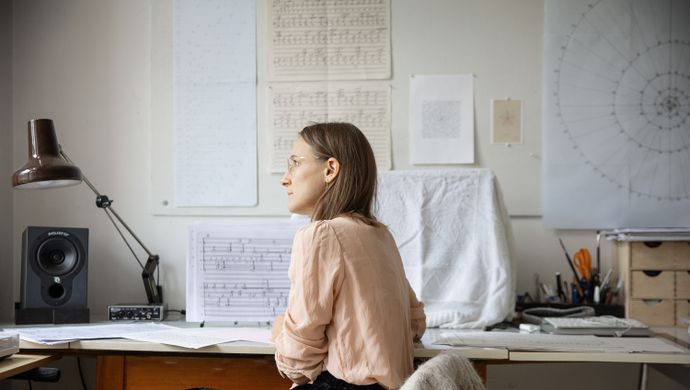
Bas Wiegers (photo Foppe Schut)
Gut strings and premieres
Bas Wiegers (1974) began his musical career, like many of his fellow conductors, in the orchestra. He studied violin in Amsterdam, under Johannes Leertouwer and Peter Brunt, and in Freiburg. Although he has a reputation for being a ‘contemporary music specialist’, his roots lie in historical performance practice. As a violinist with ensembles such as the Netherlands Bach Society and Anima Eterna, he worked with giants like Gustav Leonhardt and Ton Koopman. A tremendous learning experience, says Wiegers, even if it was hard graft on those “bloody gut strings”: 'After all, you want to go louder than the trombones.'
He was also a violinist with the Asko Ensemble (the predecessor of Het Muziek), where he learnt the ropes from conductors such as Reinbert de Leeuw and Oliver Knussen – to name two polar opposites. In 2009, he received a grant from the Kersjes Fund to focus on conducting, and in 2012 he assisted the then chief conductor Mariss Jansons with the Royal Concertgebouw Orchestra. In short, one cannot accuse Wiegers of having painted himself into a stylistic corner. On the contrary, it seems that his wide-ranging interests reinforce one another and deepen his musicality. As a guest lecturer in orchestral conducting at the Conservatorium van Amsterdam, he passes his knowledge on to the next generation.
Although he has now conducted virtually all Dutch orchestras and ensembles (he recently returned to the Rotterdam Philharmonic), a large part of Wiegers’ work takes place abroad. This season marked his debut with the Hong Kong Sinfonietta and the Orchestre National de Metz; his schedule for next season includes a prestigious debut at the Bavarian State Opera conducting Georg Friedrich Haas’s opera Koma. Since 2022, he has served as one of the three associated conductors of the Munich Chamber Orchestra, which no longer employs a single principal conductor. Prior to this, he was a regular guest conductor with Klangforum Wien, one of the world’s premier contemporary music ensembles. A glance at his schedule reveals that in the coming months, Wiegers will perform works by his compatriot Johannes van Bree (the wondrous 1845 Allegro for four string quartets), Ravel, Poulenc, Stravinsky, Pärt, Olga Neuwirth, and a handful of composers virtually unknown to Dutch audiences.
Wiegers’ versatility is a breath of fresh air in a music world prone to pigeonholing. 'Personally, I don’t give it a second thought', says Wiegers. 'I don’t approach a Mozart score any differently than a piece that’s just been written. I look at what’s on the page and explore my own emotional response to it. It does help, though, if I can send the composer an email when I have questions. You can’t exactly ring Mozart up anymore. And when I’m in Paris, I love dropping by a fellow composer like Aperghis; we get along really well. I bring some biscuits, and we just talk about music all day long.'
.png)
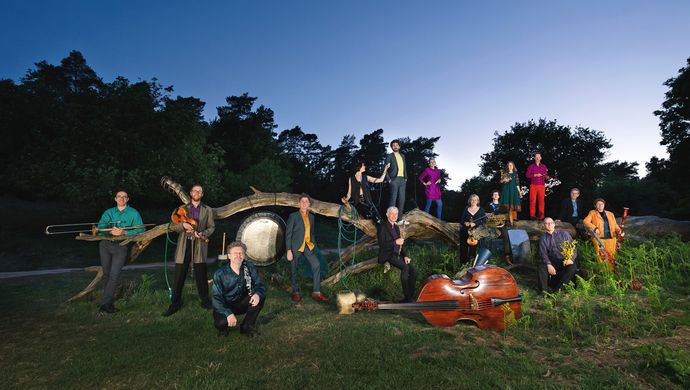
Bas Wiegers & Klangforum Wien (photo Foppe Schut)
Child of Brüggen and Reinbert
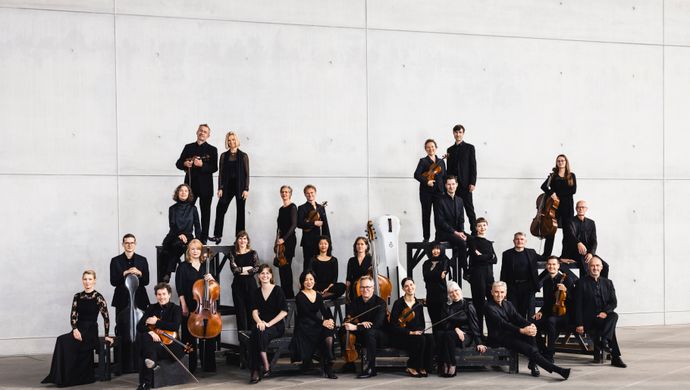
That broad perspective is a perfect fit for the Muziekgebouw, which, after all, in Wieger’s words, was founded for all music. Needless to say, Wiegers performs new works and modern classics with the specialist ensembles Klangforum and Musikfabrik. But his performance on 29 January with his very own Munich Chamber Orchestra (MKO) offers something more. Alongside a world premiere, the programme includes Béla Bartók’s Violin Concerto No. 2 featuring star violinist Leila Josefowicz, as well as Haydn’s Symphony No. 102. Wiegers holds a particular fondness for Haydn.
The world premiere with the MKO is a new work by the Dutch-Canadian composer Trevor Grahl, who recently won the biennial Matthijs Vermeulen Award for best composition with his organ piece Spiewnik. While Grahl is mostly known in the Netherlands among organ enthusiasts, Wiegers describes him as both a 'phenomenal composer' and 'one of the finest orchestrators in the Netherlands': 'It’s a bit baffling that he doesn’t write for orchestras here more often. I’m really looking forward to his new work; he’s coming to Munich for workshops with the musicians. The MKO is not a specialist ensemble like Klangforum, but it is a very adventurous orchestra that tackles such projects well.'
On 19 November, Wiegers and Klangforum will perform the world premiere of a new work by Catherine Lamb, followed by György Kurtág’s song cycle Messages of the Late Miss R.V Troussova, featuring soloist Viktoriia Vitrenko. Later, on 14 January, he joins forces with Musikfabrik to pair premieres by Rebecca Saunders and Mathias Spahlinger with Elliott Carter’s Double Concerto for Piano and Harpsichord, featuring piano soloist Pierre-Laurent Aimard. Wiegers is no stranger to Carter’s work, and he performed it previously with Aimard: 'It’s a magnificently intricate and colourful piece, and a total joy to rehearse. My approach comes from watching Ollie Knussen: first, you strip it down completely, then you reassemble the pieces with clinical precision. Every soloist has their own orchestra – sometimes even their own metre – which forces me to split my brain in two. It’s a fantastic physical challenge.'
Wiegers describes himself as 'a child of both Frans Brüggen and Reinbert de Leeuw', referring to the two iconic figures from the worlds of early and contemporary music respectively, with whom he has collaborated extensively. It is sometimes overlooked that Brüggen, founder of the Orchestra of the Eighteenth Century, was also a prolific recorder player who premiered numerous modern works. 'For many musicians, especially those of the generation after me, it’s completely normal to combine early and contemporary music. But that used to happen back in the day, too. I recently came across a 1969 Concertgebouw Orchestra program from the time of the Notenkrakersactie. Haitink was conducting Gabrieli and Mozart, and there was also a world premiere by Slagwerkgroep Amsterdam, which still existed back then. The idea that no new music was played at that time just isn’t true.'
.png)
Bas Wiegers (photo Foppe Schut)
Treasure hunting
Wiegers isn’t just a conductor these days; he is a podcaster too. He started The Treasure Hunt in 2022: 'When I’m preparing for a concert, I have in-depth conversations with the composer or the musicians. When I started working on Georg Friedrich Haas’s opera Sycorax, which I know well, I found myself wanting to talk about it, to share my enthusiasm. I thought our conversations might also be of interest to concertgoers, as a way to prepare for the performance. Think of it as a pre-concert conversation you can listen to on your own time.'
Sharing his enthusiasm is something Wiegers has always done (and excels at): 'My conducting career began with the Ricciotti Ensemble and the National Youth Orchestra of the Netherlands; roles that required constant audience engagement and outreach. But in the regular concert scene, there isn’t always room for that.' He produces the podcast entirely on his own, handling everything from recording to editing. New episodes are released on an irregular basis.
The title The Treasure Hunt says a great deal about how Wiegers works. 'When I study a score, I go in search of the treasure. The notes or the moment that everything revolves around. Sometimes that treasure is the same for everyone, like the flute’s entrance in the slow movement of Ravel’s Piano Concerto in G. Sometimes it is different for everyone. I’m not sure if the treasure I find is the same treasure the composer hid. As long as I have found the treasure for myself. You have to be convinced of it; otherwise, I can’t go on stage. Which, of course, doesn’t mean that exactly the same thing happens every time. The truth only applies tonight at a quarter past eight. Tomorrow night, it will be different.'
In a recent episode, Wiegers poses the question: how do you remain curious in a world that seems to favour certainty and things we already know? This question defines Wiegers as a musician. Whether the notes were written by Joseph Haydn in 1794 or by Trevor Grahl, they derive their meaning from our ability to set aside all preconceptions for a moment and choose to really listen.
Bas Wiegers in season 2026/2027
Carter and more
Ensemble Musikfabrik, Pierre-Laurent Aimard + Bas Wiegers
Bartók’s intense violin concerto
Münchener Kammerorchester, Leila Josefowicz + Bas Wiegers